Recent Posts

Showing posts with label Eyewitness. Show all posts

Wednesday, December 3, 2014

The Odd Couple

Justice and the Rule of Law

It was a good idea at the time

In the wake of the upheaval of the Ferguson decision, I thought it would be good to go back and look at the definitions of justice and the rule of law.  It seemed to me that refreshing my memory on these notions would help me put the case into perspective.  However, I was soon reminded that these concepts are attempts to define things that are not only asymmetrical but are also constantly changing.  Further, the intersection of the two don’t necessarily integrate like a glove fits a hand.

Surprised, but not pleasantly

The good news is that the review has helped me put the case into a framework I can grapple with, albeit not in the form I thought would emerge. Instead of rigid and clearly defined “rules” I came away with a more philosophical perspective.  The downside of that is that my practical side was left wanting.

History speaks

One quote jumped out during my research was taken from the Federalist Papers.  James Madison wrote: “If men were angels, no government would be necessary.  In framing a government which is to be administered by men over men, the great difficulty lies in this: you must first enable the government to control the governed; and in the next place oblige it to control itself.”

I’m no angel

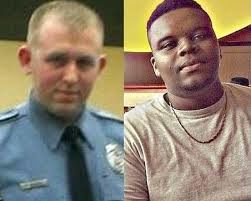
This is quite the challenge, given that no men are “angels” as Madison asserts. And certainly what constitutes an angel can be debated ad nauseam as well. What was clearly on display in Ferguson was a challenge for the fallen angels involved to live up to a standard of morality.  As a citizen, Brown was expected to obey the officer’s commands.  As an agent of the government, Wilson was expected not to usurp the rights of Brown.  As we all know, things went horribly wrong.

Served but…..

www.eurweb.com
So what about Ferguson….was justice served? The rule of law prevailed as the grand jury system worked.  The evidence was methodically scrutinized and it did not generate an indictment of the officer. The morality of the times prevailed.  But did the system serve the needs of the community?  The perception of minority oppression by police remains, despite the process having produced a predictable outcome.  While this remains a formidable issue, in a larger sense, the protests of this tragedy transcended racial and minority misgivings and remind all Americans that our government must be "obliged to control itself".    

Assurances of control

Already the future of policing is likely to be impacted.  The President suggested funding body cameras for police officers so that video and audio recordings can be captured as they discharge their duties. While it seems that Madison's astute observation is being acknowledged, one wonders if this will ensure the equitable administration of justice or diminish the effectiveness of police.

Pandora was here

More questions than answers were generated which, I suppose, is the nature of law.  What is certain; however the future is uncertain.  History shows us that the legal system changes to meet the needs of the time.  What then, will the changes end up being in the wake of Ferguson?  Consider some definitions of Justice as you ponder:

Jus-tice (Noun)

  1. The quality of being just; righteousness, equitableness, or moral rightness;
  2. Rightfulness or lawfulness, as of a claim or title; justness of ground or reason
  3. The moral principle determining just conduct.
  4. Conformity to this principle, as manifested in conduct; just conduct, dealing or treatment.
  5. The administering of deserved punishment, reward
  6. The maintenance of administration of what is just by law, as by judicial or other Judgment of persons or causes by judicial process


Wednesday, June 25, 2014

Eye Witness Testimony

Modern Understanding of the Brain Changes Court Rules

As seen on TV

It is dramatic when an eye witness picks someone out of a line up.  You see it on TV and you think it works that smoothly in the modern world.  For sure, line-ups are still used but maybe this technique will begin to fall out of favor as it is revealed how flimsy eye-witness testimony can be.  As our understanding of human functioning increases, backed by scientific research, we are finding that our memories are more fallible than once perceived.

Brains are not computers

gadgetadda.com

One such theory of how memory fails us is something called Source Confusion.  This happens when we recall something incorrectly and the source of the error is attributed to some other real experience we had that was similar or familiar. Psychologists explain that the brain does not store and recall images and memories like a computer does.  It is not that simple.  Rather, there are many factors that cause the storage and recall of images and events to be altered.  These may include the length of time the event was observed, the lighting, the speed of the event, and its distance from the observer.  Also, emotional factors play a part in how brain storage and recollection is carried out.  Stress, anger, apathy, etc can alter the event in ones mind.

The eyes have it

Another revealing phenomenon that shows how eye-witness recollection is unreliable is the proliferation of surveillance cameras in public and private settings.  A recent case in Pittsburgh shows how a public library camera exonerated a robbery suspect.  While cameras help increase positive identification of suspects, they also are becoming good sources of alibis.

Cameras are good for business

The story also reveals that the robbery victim may have suffered some sort of Source Confusion as he accused a regular patron as being the robber.  Maybe if the shop owner had a camera in his store they would have caught the right guy and he wouldn't have lost a good customer in the process!

A major ruling for the good of both sides

The increasing evidence that points to the inherent weaknesses in eyewitness testimony has caused changes in the way law enforcement and prosecutors must now present their cases.  There are now only three states which ban testimony by experts who testify about eyewitness testimony.  In May, Pennsylvania joined the majority of states who allow this type of expert testimony which will inform jurors of the limits of eyewitness testimony.  The ruling will continue the trend of cases built on science based evidence.  

Science fact

Just as DNA evidence has become the gold standard for scientific proof in the courtroom, the next breakthrough may come in the form of validating eyewitness testimony that is true and correct.  Right now, that may be the stuff of science fiction but people commonly wearing micro-cameras may not be far off. Google glasses are an early entry into that market and as privacy concerns decrease, they may be more commonplace.  Someday, the images they capture may be routinely admitted into evidence. "I told you so”, said George Orwell.

Tuesday, December 10, 2013

Seeking an elusive truth

Flaws in criminal justice system can lead to errant convictions


We the people, in prison

The prisoner population in the US is large.  Roughly 1.6 million citizens were imprisoned in 2010 and another 1.4 were under supervision of parole and probation officers.  The US also imprisons more people per capita than any other comparable nation; about 500 people out of every 100,000 people. Only recently has the prison population seen a decrease but even then, it is a minimal drop.  The decrease has been attributed to everything from new thinking in rehabilitation methods to correctional budget cuts.  None-the-less, given the size of the prison population, mistakes pertaining to the guilt or innocence of defendants will be made.

The dream of unbiased justice

The expectation for excellence in the criminal justice system is very high when it comes to investigating and prosecuting crime.  On one hand society demands law and order and for the right of victims to attain justice.  At the same time, we require the standard of reasonable doubt to balance our thinking.  If not, many innocent people might end up being wrongfully imprisoned. Famous for this sentiment is English jurist Sir William Blackstone who commented “It is better that ten guilty persons escape than that one innocent suffer”; words taken to heart by the founding fathers.  However, because the justice system is made up of people, it will generate its fair share of errors, oversights and even malicious intents and invariably, innocent people are sentenced to prison or even death.  

Technology won’t solve all inequities

The advent of DNA technology has changed the way cases are investigated and adjudicated.  DNA has also exonerated hundreds of wrongfully imprisoned citizens.  Groups like the Innocence Project have dedicated themselves to bringing this technology to bear in cases where the potential for error is great.  But DNA is not always a component of decisions that wrongfully land defendants in jail.  Academics have identified several other factors that cause errors in cases that can lead to errant convictions.

Human imperfections

Identifying the truth can be challenging when you realize the outcome of these critical factors hinge upon the integrity, professionalism and unseen motives of the people involved.

  1. Eyewitness misidentification. Research shows that human recall is not infallible.
  2. Faulty Forensic Science.  The science and the scientist are not always credible. 
  3. Bogus confessions/admissions.  Defendants ignorantly self-incriminate or are coerced to hide the truth.  
  4. Government Misconduct.  Measurements of success (convictions) can cloud the judgment of the people who make up the system. 
  5. Informants.  The motivation and truthfulness of informants is not always known.  
  6. System stress.  Overworked and underfunded defense council perpetuates bad outcomes.  

www.theguardian.com

Moving toward a better system

Making justice accessible to all in need is a noble endeavor and efforts to form a more perfect justice system are underway.  Contributing to this goal, professional investigative firms like CSI can act on behalf of the defense before the case goes to trial.  Validating or deconstructing the facts as gathered by law enforcement can make or break the outcome of the case. Investigation of cases post-conviction can also validate the legitimacy and integrity of suspect decisions.  In the long view, this fact checking can challenge the status quo of the criminal justice system and raise its standard of excellence.  It may also prevent or reverse undesirable outcomes along the way.